
Upper St. Clair City Directory Collections
The verified starting collection is Historic Pittsburgh’s digitized set of Pittsburgh and former Allegheny City directories. It covers 1837 through 1930, with gaps. That date range is useful, but a result does not automatically place a household in Upper St. Clair Township. The Township sat outside the core city, and each volume must be checked for its geographic reach. No authoritative source reviewed here established a Township-specific printed run, a publisher sequence, or a complete local shelf list.
| Collection | Years | Where Held | Access |
|---|---|---|---|
| Historic Pittsburgh city directories | 1837–1930, with gaps | Historic Pittsburgh digital collection | Online; verify a volume’s geographic scope. |
| Later metropolitan directories | Beyond 1930; exact runs not verified | Carnegie Library Pennsylvania Department and Heinz History Center Detre Library & Archives | Ask staff for a person, address, and year. |
| Upper St. Clair Township Library | Exact directory years not verified | 1820 McLaughlin Run Road | Catalog, staff inquiry, and FamilySearch affiliate access. |
| Historical Society of Upper St. Clair archives | Undated local holdings | Historical Society and Historic Pittsburgh | Digitized images plus inquiry for unscanned material. |
| Pennsylvania State Library genealogy material | Varies by item | State Library of Pennsylvania | Some use is in-library or by library loan/copy request. |
Historic Pittsburgh’s directory FAQ is the documented source for the collection shown below.
The collection offers a sound first check, not a promise that every Upper St. Clair household appears in every year.
Upper St. Clair City Directory Coverage Limits
A missing name needs a careful reading. It can mean the volume did not cover the Township, the directory has a gap, the person used initials or a variant spelling, or the household was omitted under that publication’s practices. It is not proof that a person was absent from Upper St. Clair. Record the volume title, publisher, year, page, spelling, and any coverage note before moving to another source.
Historic records may use the older St. Clair Township geography rather than the modern Upper St. Clair Township name. The older township was divided repeatedly. Try a historic road, farm, plan name, adjacent municipality, or the broader St. Clair Township term beside the surname. That adjustment is especially important for early land and family research.
Keep a source log even when the answer is negative. Write down the exact volume, the search spelling, and whether the place is inside the book’s stated scope. A later inquiry can then test another spelling or a neighboring locality without silently repeating the same search. This also separates a true collection gap from a person who may be listed under a different name or address.
Upper St. Clair City Directory Requests
For later volumes or telephone books, give a reference desk a narrow request: surname, street or subdivision, approximate year, and the format sought. Carnegie Library of Pittsburgh’s Pennsylvania Department and the Heinz History Center’s Detre Library & Archives are the documented regional places to ask about metropolitan and county directories beyond the digitized run. A broad request to “find a person” gives staff little to search.
The Upper St. Clair Township Library is another local starting point. It is at 1820 McLaughlin Run Road and can be reached at 412-835-5540. It is a FamilySearch affiliate library, which supports guided genealogy access and catalog inquiry, but it does not establish that every directory is held locally. Ask for a surname, street or plan, time window, and a specific format such as a telephone book, map, clipping, yearbook, cemetery record, or historic photograph.
- Start with the exact spelling used in a family paper or deed.
- Give a range instead of assuming one exact year.
- Ask whether the requested volume reaches the relevant geography.
- Request the title-page and page citation with any transcription.
Note: Exact Upper St. Clair Township Library directory years were not verified in an official online holdings list.
Reading an Upper St. Clair City Directory
The inspected collection description confirms that city directories can support address and ward research, but it did not expose a complete Upper St. Clair entry or abbreviation page. Treat the items below as an inspection checklist, not as a transcription of a local volume. Copy what the actual page prints, including initials, abbreviations, spelling, and punctuation. A volume’s own key controls what its marks mean.
| Name | Surname, given name, initials, and any printed spouse or widow reference. |
|---|---|
| Address | The street address as printed, checked against the volume’s coverage. |
| Work notation | Occupation or business notation if the specific entry includes one. |
| Household clue | Any printed relationship, widow notation, or associated name. |
| Source citation | Title page, publisher, year, page, and the volume’s abbreviation key. |
- Criss-cross directory
- A later directory arranged by address rather than by surname. No Upper St. Clair run was verified, so ask a reference desk before relying on one.
- Householder index
- An index that points to a household or address within a particular publication; its coverage is limited to that volume.
- Abbreviation key
- The publisher’s explanation of shortened terms and symbols, usually near the front of the volume. Preserve it with the entry notes.
A printed entry can support a search for the same household in another dated source. It cannot establish ownership, every household member, or continuous residence. Preserve uncertainty in the notes, especially when an entry’s road name, initials, or municipality differs from a later record.
Upper St. Clair City Directories and Local Files
The Historical Society of Upper St. Clair gives the directory search a local layer that metropolitan books may miss. Its digitized material shows residents and families, schools, houses, major roads, landmarks, and the Township’s change from an agricultural community. Its larger holdings include photographs, scrapbooks, subject files, correspondence, oral histories, personal papers, clippings, maps, manuscripts, and materials from local families, businesses, and organizations.
The Historical Society’s Historic Pittsburgh collection is the online starting point for these Township-focused materials. Ask about a former farm, road, school, subdivision, family, or date. The circa-1830 Fulton Log House, the last surviving Gilfillan Farm worker house, is a useful landmark for early road and land context, but it does not prove any particular family lived at a property.
This agricultural-to-suburban record trail is a better local clue than an invented directory run. Photos, maps, and family papers can translate an old road or farm reference into a place to test against deeds and later addresses.
Tracing an Upper St. Clair Household
A city directory is a dated lead, not a census or title record. Build a small timeline around one name or one confirmed address. Use a released federal census only after the federal 72-year interval, then compare age, birthplace, household members, and address or ward context. County assessment and deed records answer a different question by connecting a parcel to assessed ownership and the recorded transfer trail.
- Find the most appropriate directory or telephone book for the surname or address.
- Write down the entry exactly, with the title, year, page, and coverage information.
- Check the next earlier and later available volumes for moves, spelling changes, or a missing entry.
- Compare a nearby released census for household and age context.
- Use the county parcel and deed route to separate ownership from an address listing.
A disappearance can reflect a move, death, changed spelling, an incomplete volume, or geography outside the book. An obituary, estate docket, cemetery record, or mature death record can supply a next lead, but each needs its own source check.
Upper St. Clair City Directory Name Checks
For a historic family question, Pennsylvania’s date rules help decide whether a vital record can add context. Statewide birth certificates begin in 1906 and become public at 105 years. Death certificates become public at 50 years. Earlier possibilities can include county registers, churches, cemeteries, and deposited local material. These records can clarify identity or family dates; they do not turn a directory entry into proof of residence.
Pennsylvania State Archives birth-record guidance is represented in the source image below.
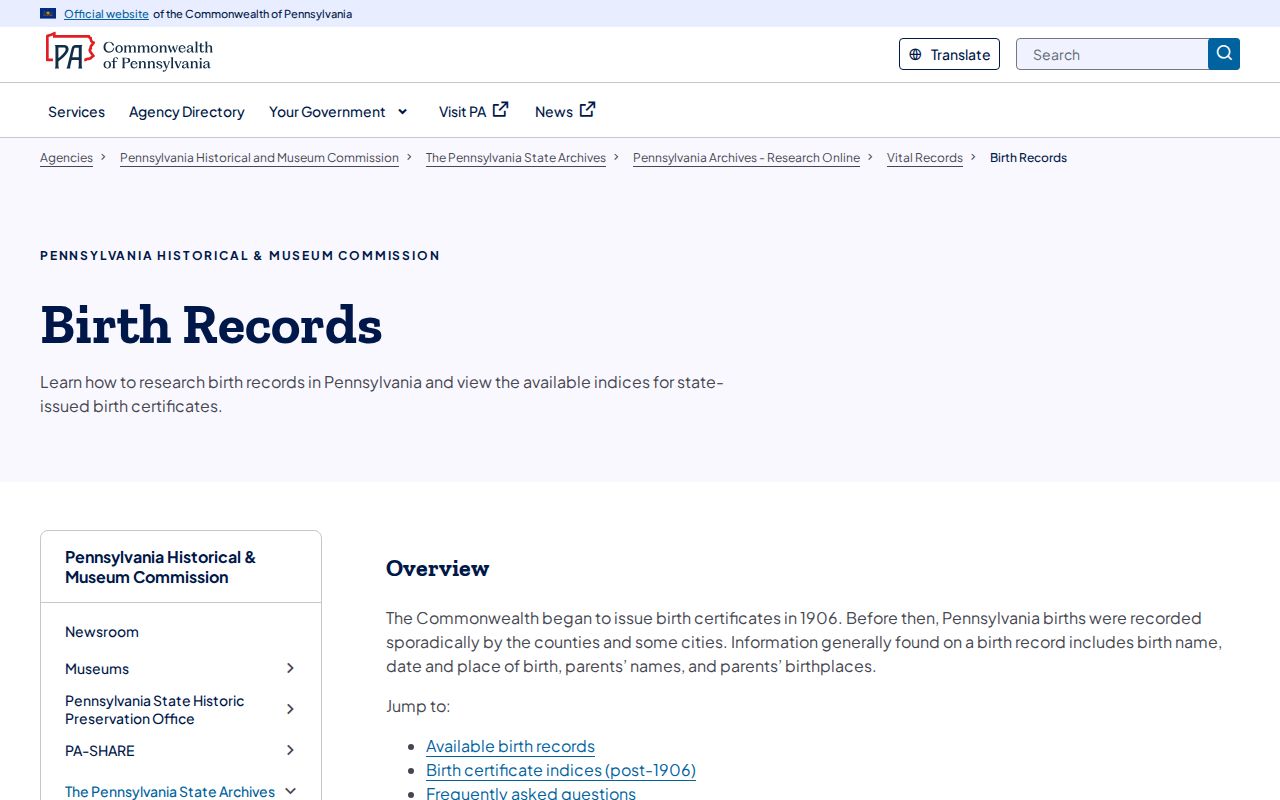
Use an event year before ordering or requesting a copy. Archive requests require the indexed name, date, certificate number, and sometimes month and county. The State Archives historical birth and death request route is also documented by this source capture.
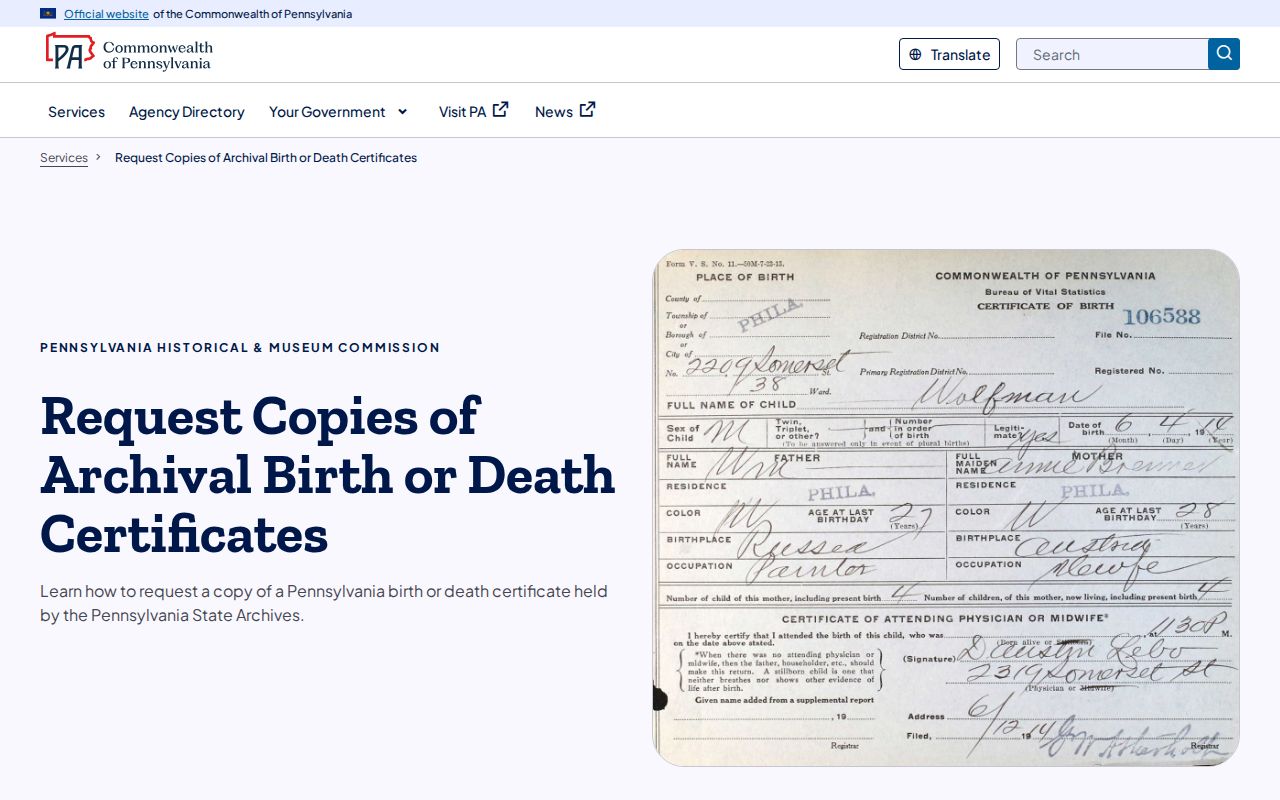
That request path can help close a family-history timeline after the directory and census evidence have been compared.
Upper St. Clair City Directory Timeline
The usable chronology is regional and archival. It does not supply a verified first or last Upper St. Clair printed directory. Keep the following dates attached to the correct record system rather than blending them into one local publication history.
| Period | Record context |
|---|---|
| 1788 | Allegheny County formed, beginning the documented historic grantor and grantee index chronology. |
| 1837–1930 | Historic Pittsburgh’s digitized Pittsburgh and former Allegheny City directory collection, with gaps. |
| 1906 onward | Pennsylvania statewide birth certificates begin, subject to the 105-year public period. |
| 1906–1968 | State Archives holdings include Allegheny County naturalization petitions and record books in digitized rolls. |
For an early property trail, the State Archives’ historic deed indexes and land-office materials belong beside the directory work. The county deed chain begins with county conveyances, while original Commonwealth land records concern the earlier tract history.
Naturalization petitions and record books can extend a family search beyond a directory entry when a person’s name and period are already known. The State Archives lists Allegheny County material from 1906 through 1968 in eight digitized rolls, along with land warrants and miscellaneous land records from 1769 through 1851. Those holdings are related research routes, not evidence that any one Upper St. Clair resident appears in them.
Note: No verified Upper St. Clair criss-cross run, Sanborn list, or final local printed-directory year is asserted here.